WarningAlerts
Brotli decoder flaw is being exploited: update libbrotli, Node.js and .NET
A bug in Google’s Brotli decompression library lets a crafted compressed stream corrupt memory, and CISA says it’s being exploited. Fixed in Brotli 1.0.10, 1.1.1 and 1.2.1, Node.js 22.23.4, 24.22.1 and 26.12.1, and .NET 10.0.14, 9.0.22 and 8.0.33.
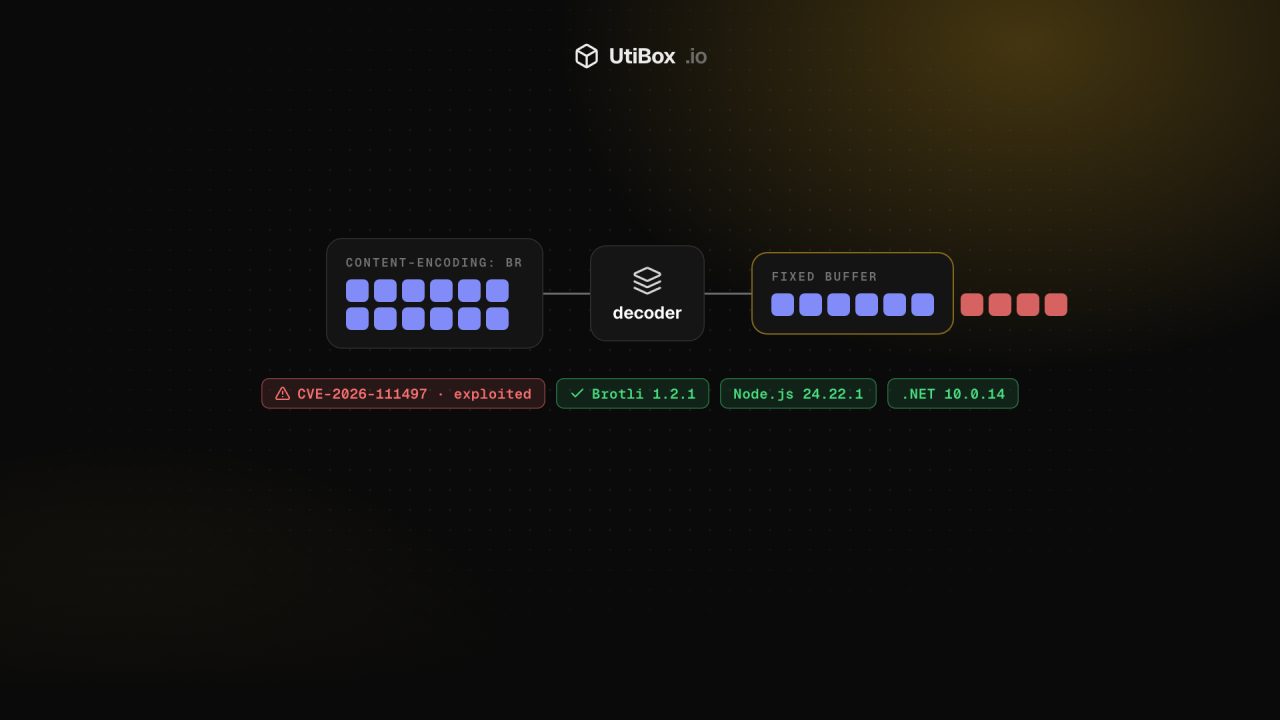
Illustration: UtiBox
Warning
OngoingBrotli decoder flaw CVE-2026-111497 is being exploited. Update libbrotli, Node.js, .NET and Python Brotli packages.
- Started
- Ends
- Not known yet
What happened
Brotli is Google’s compression format. Browsers use it to download web pages faster (Content-Encoding: br), and it’s built into Node.js, .NET, Python packages and many Linux distributions.
On 21 October 2026 Google released Brotli 1.0.10, 1.1.1 and 1.2.1 to fix CVE-2026-111497, an out-of-bounds write in the decoder. The CVE record, published by Google, says a remote, unauthenticated attacker can use “a crafted Brotli-compressed stream” to “corrupt adjacent decoder state memory, disclose sensitive memory contents, cause a denial of service, or potentially execute arbitrary code”. Google scores it 9.2 (Critical) under CVSS 4.0. It affects every version from 1.0.3 to 1.2.0.
Node.js shipped fixed releases the same day, and Microsoft released an out-of-band .NET update on 25 October. On 27 October CISA added CVE-2026-111497 to its Known Exploited Vulnerabilities (KEV) catalog, which means it has evidence of real attacks. Neither CISA nor the vendors have said which products were attacked.
The bug in plain English
The Node.js advisory explains it well. When the decoder met one particular kind of invalid data (an invalid “block switch”), it reported it as a temporary need for more input instead of a permanent format error. So the streaming decoder kept appending input bytes to an eight-byte internal buffer, writing past its end. Feed it the right bytes and you corrupt the process’s memory.
The flaw is in the decoder. The risk sits wherever your software decompresses Brotli data that someone else created, for example:
- an HTTP client that accepts Brotli-compressed responses from servers you don’t control (webhooks, scrapers, link previews, API integrations);
- an API or web server configured to accept compressed request bodies;
- any app that unpacks
.brfiles or streams supplied by users.
Node.js
The Node.js security releases announced on 21 October fixed CVE-2026-111497 (rated High) in all three supported lines. Node.js says an attacker “who can supply Brotli data that an application decompresses with node:zlib” can crash the process, read process memory, or run code.
| Line | Fixed in |
|---|---|
| Node.js 26 | 26.12.1 (26.13.0 is now the LTS release) |
| Node.js 24 | 24.22.1 |
| Node.js 22 | 22.23.4 |
Across the three lines, the same releases fixed nine other bugs, including several in how certificates are checked for IP addresses, so they’re worth having anyway. Node.js says end-of-life versions are affected too and should be upgraded to a supported line.
.NET
Microsoft’s out-of-band releases 8.0.33, 9.0.22 and 10.0.14 (25 October) fix the bundled Brotli. Microsoft says apps are affected “if they use Brotli decompression through ASP.NET Core request decompression, HttpClient automatic response decompression, or the System.IO.Compression Brotli APIs”. It adds that automatic request and response decompression aren’t enabled by default, and that .NET Framework isn’t affected.
Note that .NET 8 and .NET 9 reached end of support on 10 November 2026, so the long-term answer is .NET 10 (10.0.14 or later) or .NET 11.
Linux packages and Python
Distributions ship their own fixed builds of the library:
| System | Fixed brotli package |
|---|---|
| Debian 13 (trixie) | 1.1.0-2+deb13u1 (DSA-6582-1) |
| Debian 12 (bookworm) | 1.0.9-2+deb12u1 (DLA-4855-1) |
| Ubuntu 26.04 LTS | 1.2.0-3ubuntu0.1 |
| Ubuntu 24.04 LTS | 1.1.0-2ubuntu0.1 |
| Ubuntu 22.04 LTS | 1.0.9-2ubuntu0.1 |
Debian notes that its nodejs and python-brotlicffi packages use the system Brotli library, so updating the system package fixes them too. For other distributions, check their security tracker for the CVE number.
In Python, the official Brotli bindings on PyPI reached 1.2.1 on 22 October. The brotlicffi changelog says version 1.2.1.0 (21 October) upgraded its bundled library to 1.2.1, “which remediates CVE-2026-111497”. That release also starts rejecting trailing bytes after a complete Brotli stream, so test anything that used to tolerate them. In Go, the CVE record links to version 1.2.7 of andybalholm/brotli, a Go port of Brotli whose release notes say it ports an upstream change to “detect and report invalid stream earlier”.
How to check and update
# Debian / Ubuntu: update the shared library
sudo apt update && sudo apt install --only-upgrade libbrotli1

# Find running processes still using the old, deleted copy
sudo lsof -n 2>/dev/null | grep libbrotli | grep DEL

# Node.js and .NET versions
node -v
dotnet --list-runtimes

# Python packages in your app's virtual environment
pip show Brotli brotlicffi
pip install --upgrade Brotli       # or brotlicffi, whichever is installed
Restart whatever lsof lists, or reboot. For containers, rebuild images on patched base images (docker build --pull) and redeploy; a container keeps the library it was built with until you do.
If you can’t patch straight away
Find out where your services decompress Brotli data from outside, and switch it off where you can. For example, stop advertising br in an outgoing client’s Accept-Encoding header, or turn off request decompression for compressed uploads. That shrinks the attack surface, but it’s a stopgap, not a fix.
Already updating servers? Two other recent additions to CISA’s exploited list need attention on the web side: the WordPress core upgrade flaw and the GitLab CI/CD regex flaw.
Sources
- Google Brotli: release v1.2.1 (21 October 2026) (opens in a new tab)
- CVE record: CVE-2026-111497 (opens in a new tab)
- CISA: CISA Adds Two Known Exploited Vulnerabilities to Catalog (27 October 2026) (opens in a new tab)
- CISA KEV catalog entry: CVE-2026-111497 (opens in a new tab)
- Node.js: October 2026 security releases (opens in a new tab)
- .NET 8.0.33 release notes (out-of-band security update) (opens in a new tab)
- Debian security tracker: CVE-2026-111497 (opens in a new tab)
- Ubuntu: CVE-2026-111497 (opens in a new tab)
- PyPI: Brotli 1.2.1 (opens in a new tab)
- brotlicffi changelog (opens in a new tab)
- andybalholm/brotli: release v1.2.7 (opens in a new tab)
Related


More from Alerts

OutageAlerts
AO3 is down again for “preventative maintenance” after its security incident
Archive of Our Own went offline again on Thursday, 19 November, four days after it came back from a security incident. Here’s what the Organization for Transformative Works has said, and what AO3…

OutageAlerts
Hetzner Object Storage outage: FSN1 and Helsinki regions report errors
Hetzner is reporting Object Storage problems in FSN1 (Falkenstein) and HEL (Helsinki), with requests to some buckets failing or timing out and writes slowed. Here’s the latest status from Hetzner…

ResolvedAlerts
Microsoft 365 outage resolved: Outlook, Teams and SharePoint are back
Microsoft has cleared the Microsoft 365 incident that cut users off from Exchange Online, Teams, SharePoint and more. It reports sustained recovery and says an earlier network capacity upgrade was…


