WarningAlerts
Ivanti Connect Secure zero-days gave attackers root on VPN gateways
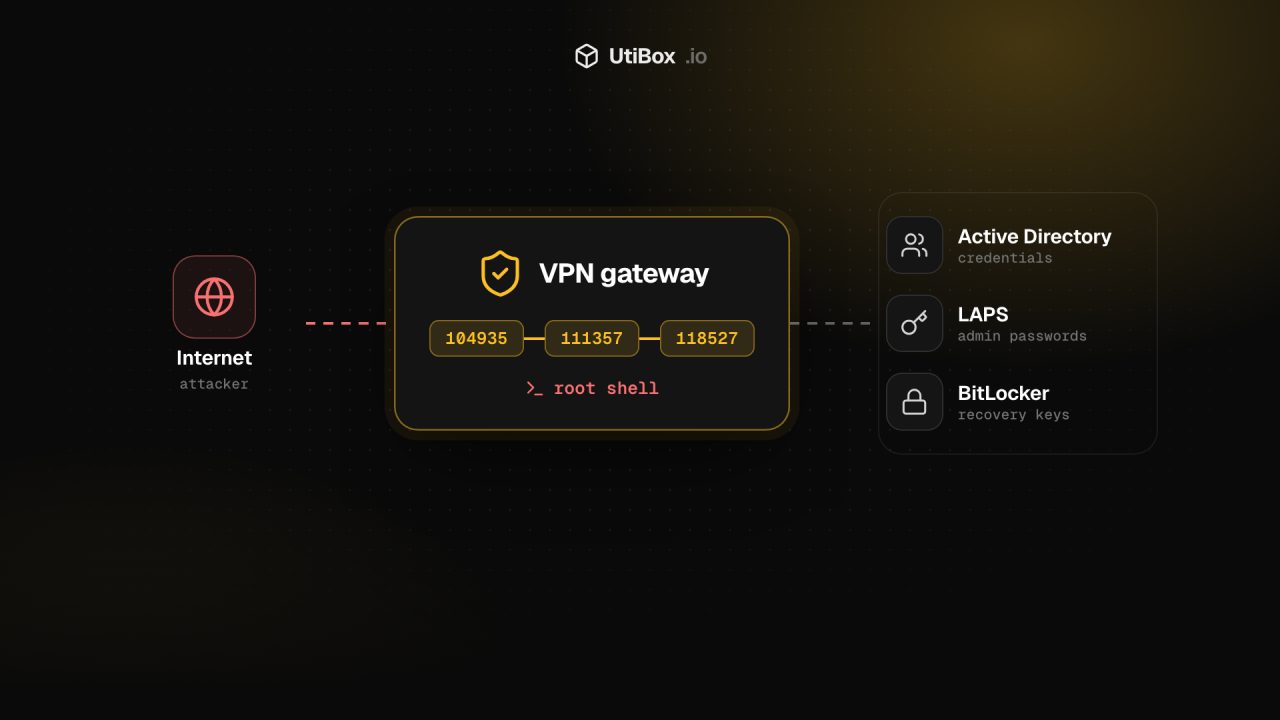
Attackers chained three Ivanti Connect Secure flaws to get root on VPN appliances without logging in, starting on 3 October. The 13 October update doesn’t fix two of them. Update to 25.1.1.3 or 22.8R2.6, then check for signs of compromise.
Illustration: UtiBox
Warning
OngoingIvanti Connect Secure zero-days are being exploited. Update to 25.1.1.3 or 22.8R2.6 and check for compromise.
- Started
- Ends
- Not known yet
On this page 6 sections
What happened
The incident response firm Volexity found a group it tracks as UTA0576 exploiting a chain of previously unknown flaws in Ivanti Connect Secure, Ivanti’s VPN gateway. According to Volexity, the attacks started on 3 October 2026 against an appliance that was fully patched at the time (22.8R2.4). The chain combines an authentication bypass in the welcome.cgi handler, a file-write flaw in wu.cgi and a privilege escalation, which together give the attacker root without logging in.
Once inside, the attackers went after Active Directory secrets, using a compromised service account to pull Windows LAPS passwords and BitLocker recovery keys over LDAP. They also deleted their traces from the Ivanti debug log and the Linux audit log. Because the exploit patches code only in memory, Volexity says Ivanti’s Integrity Checker Tool did not flag the compromise, so a clean result from that tool doesn’t prove the device is clean.
Ivanti fixed the authentication bypass (CVE-2026-104935) on 13 October and the remaining two flaws on 29 October. CISA added CVE-2026-111357 and CVE-2026-118527 to its Known Exploited Vulnerabilities catalog on 30 October 2026.
The three bugs
| CVE | Ivanti CVSS | What it does | Fixed in |
|---|---|---|---|
| CVE-2026-104935 | 8.6 | Authentication bypass: remote command execution without logging in | 25.1.1.2, 25.1.3.0 / 25.1.3.1, 22.8R2.5 |
| CVE-2026-111357 | 8.8 | Missing authentication on a critical function: local privilege escalation | 25.1.1.3, 22.8R2.6 |
| CVE-2026-118527 | 4.3 | Predictable identifiers: authenticated file upload to a known path | 25.1.1.3, 22.8R2.6 |
On its own, CVE-2026-118527 looks minor. In a chain, a low-scoring bug that lets you drop a file in a predictable place is often exactly the missing link. (The public CVE record scores CVE-2026-111357 at 7.0 rather than Ivanti’s 8.8, because they disagree on how hard it is to exploit.)
Which versions are affected
- CVE-2026-111357 and CVE-2026-118527: 25.1.1.2 and earlier, and 22.8R2.5 and earlier
- CVE-2026-104935: 25.1.1.1 and earlier, 25.1.2.2 and earlier, and 22.8R2.4 and earlier
Ivanti recommends moving from 22.8.x to 25.1.1.3 or later, and applying 22.8R2.6 only if you can’t migrate yet. It lists 25.1.3.0 and later on ISA4500, ISA6500 and ISA8500 hardware as unaffected.
How to check for compromise
Volexity’s guidance, which Rapid7 also summarises: Where you can, preserve memory and logs before you reboot or reset the appliance, because a reboot can destroy evidence.
- Look in web logs for high volumes of requests to
/dana-na/auth/url_default/welcome.cgi, and for requests where the URL path and theX-DSCGI-PATHheader don’t match. - Review files in
/tmp/,/data/.icscap/and/home/runtime/tmp/. - Check
/var/log/audit/audit.logand the Ivanti debug log for signs that individual entries were deleted. - Block and search for traffic to
108.165.147[.]64, an address Volexity links to UTA0576.
If you find anything, follow Ivanti’s recovery steps and assume that every credential the gateway handled is exposed. That means VPN user passwords, service accounts it used to talk to Active Directory, and, given what the attackers went after, LAPS passwords and BitLocker recovery keys.
Why VPN gateways are such a target
Edge devices such as VPNs, firewalls and file-transfer appliances sit on the internet by design, often run closed firmware that defenders can’t easily inspect, and hold the keys to the internal network. If you run one, treat its advisories like those for your most critical servers: patch outside your normal cycle, and send its logs somewhere the device itself can’t wipe.
Sources
Related


More from Alerts

WarningAlerts
WordPress core flaw CVE-2026-119977 is being exploited: update to 7.1.4
CISA says attackers are exploiting a WordPress core bug that lets anyone run code on the server while a core upgrade is in progress. Every version from 4.7 to 7.1.3 is affected. Make sure each site…

WarningAlerts
“sshole”: any long password logs in to some Alpine and musl SSH servers
On musl-based systems such as Alpine Linux, OpenSSH without PAM could accept any password longer than 256 characters for accounts that have no password set. Update OpenSSH to 10.6p2 (or Alpine’s…

WarningAlerts
Patch PHP now: the “php2shell” flaws are under active attack
Two remote code execution bugs in PHP itself, CVE-2026-109618 and CVE-2026-109619, are on CISA’s list of exploited vulnerabilities. Update to PHP 8.5.12, 8.4.27, 8.3.36 or 8.2.35, then restart PHP.


