OutageAlerts
Hetzner Object Storage outage: FSN1 and Helsinki regions report errors
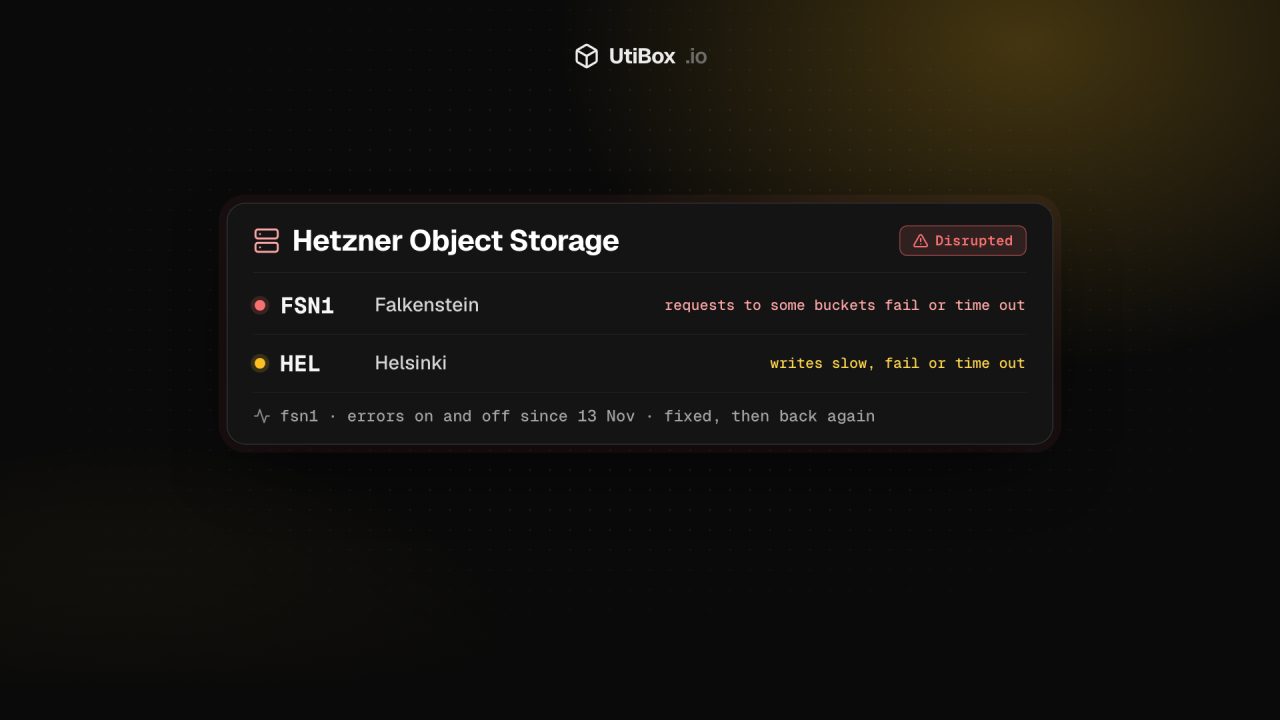
Hetzner is reporting Object Storage problems in FSN1 (Falkenstein) and HEL (Helsinki), with requests to some buckets failing or timing out and writes slowed. Here’s the latest status from Hetzner and what website operators should check.
Illustration: UtiBox
Outage
OngoingHetzner Object Storage: FSN1 and Helsinki report service degradation. Some bucket requests or writes may fail or time out. Provider-reported.
- Affects
- HHetzner
- Last check
- Up · 405 msjust now
- Provider says
- Outage reportedHetzner status
- Posted
- Ends
- Not known yet
Hetzner is reporting problems with Object Storage in its FSN1 (Falkenstein) and HEL (Helsinki) locations. Its incident notices describe failing or timed-out requests to some buckets and slow or failed writes. The notices cover these two Object Storage locations. They don’t describe an outage of Hetzner’s whole hosting platform. Here is the latest status from Hetzner and what website operators can check.
What happened
Hetzner opened two separate incidents, one per location.
- HEL (Helsinki), from 11:14 UTC on 13 November. Hetzner wrote that the service “is currently partially degraded. Write operations may take unexpectedly long or fail or time out.” It added that it is “already working on fixing the issue”.
- FSN1 (Falkenstein), from 00:40 UTC on 14 November (7:40 pm Eastern on 13 November). Hetzner wrote: “Object Storage service in location fsn1 is currently only partially available. Requests to some buckets may fail or time out.”
The FSN1 incident has gone back and forth. Hetzner moved it to monitoring after a fix at 03:13 UTC on 14 November. On 15 November it reported elevated errors again at 02:20 UTC, and called it fixed again at 04:49 UTC. The errors returned at 07:24 UTC, and it reported another fix at 07:42 UTC. Hetzner hasn’t named a cause for either incident.
This isn’t the first FSN1 storage problem this autumn. Hetzner’s status page also lists FSN1 Object Storage incidents on 18–19 October (about 21 hours) and on 6 November (08:55 to 14:45 UTC).
What may be affected
Hetzner’s notices name three symptoms: failed or timed-out requests to some buckets in FSN1, and slow or failed writes in HEL. What that means for a website depends on how it uses the storage. Things that commonly depend on a bucket include:
- Uploads: images, documents and other files that users upload and that are saved to the bucket.
- Media delivery: pictures or downloads served straight from the bucket, or through a CDN that fetches from it.
- Backups: nightly database or file backups written to the bucket.
- Background jobs: queues or workers that read or write objects.
These are possible effects, not confirmed ones. Hetzner hasn’t said how many buckets or customers are affected, and it hasn’t reported any data loss.
Who is affected
Customers using Hetzner Object Storage in FSN1 or HEL. Hetzner lists no current incident for its cloud servers, dedicated servers, Storage Boxes or its other Object Storage locations. If your website runs on a Hetzner server but doesn’t use these buckets, these incidents shouldn’t affect it.
What website owners should do now
- Check which location your buckets are in. The endpoint tells you: buckets in Falkenstein use an fsn1 address, buckets in Helsinki a hel1 address.
- Read your own logs. Look for timeouts, 5xx responses and retries from your S3 client. That tells you whether your buckets are affected, which Hetzner’s status page can’t.
- Retry with limits. Use bounded retries with exponential backoff and a sensible timeout. Don’t retry writes endlessly: a write that timed out may still have succeeded, and blind repeats can create duplicate objects or duplicate jobs.
- Check your backup jobs. If a backup writes to FSN1 or HEL, confirm that each run finished. Once Hetzner reports the service stable, run any failed ones again.
- Tell your users what’s happening. If uploads are failing, a short notice saying uploads may be slow or fail for a while saves you support tickets.
- Verify after recovery. When the incidents close, spot-check recent uploads and restore a backup on a test system to make sure the files are complete.
How to check the incident
Hetzner’s own pages are the source of truth:
- FSN1 Object Storage incident (opens in a new tab)
- HEL Object Storage incident (opens in a new tab)
- Hetzner status page (opens in a new tab) (it also publishes an Atom feed)
Our Hetzner status page reads Hetzner’s official feed every two minutes and shows each update. When Hetzner closes the incident, this alert switches to resolved by itself.
A word on our checks: UtiBox tests whether a public website loads from our server. That can’t see inside a private bucket, and it can’t tell a regional storage problem apart from an unrelated fault on your site. If you serve files from a public bucket URL, the HTTP Status Checker can show whether one file answers right now. Never paste private bucket addresses or access keys into any online tool.
Live updates
Every update Hetzner has posted, in order. Times are UTC, with Eastern time in brackets.
| Time (UTC) | Location | Hetzner status | What Hetzner said |
|---|---|---|---|
| 13 Nov, 11:14 (6:14 am) | HEL | Investigating | Writes may take unexpectedly long, fail or time out |
| 14 Nov, 00:40 (13 Nov, 7:40 pm) | FSN1 | Investigating | Requests to some buckets may fail or time out |
| 14 Nov, 03:13 (13 Nov, 10:13 pm) | FSN1 | Monitoring | “We have fixed the error” |
| 15 Nov, 02:20 (14 Nov, 9:20 pm) | FSN1 | Investigating | Elevated error levels, investigating again |
| 15 Nov, 04:49 (14 Nov, 11:49 pm) | FSN1 | Monitoring | “We have fixed the error” |
| 15 Nov, 07:24 (2:24 am) | FSN1 | Investigating | Elevated error levels, investigating again |
| 15 Nov, 07:42 (2:42 am) | FSN1 | Monitoring | “We have fixed the error. We are monitoring the systems closely.” |
FAQ
Is Hetzner completely down? No. Hetzner reports problems with Object Storage in two locations, FSN1 and HEL. It lists no incident for its other services.
Which regions are affected? FSN1 (Falkenstein, Germany) and HEL (Helsinki, Finland), and only their Object Storage.
Could this break my website? Only if your website uses buckets in those locations, for example for uploads, images or backups. A site that only runs on a Hetzner server isn’t affected by these incidents.
Is this a cyberattack? Hetzner hasn’t said what caused either incident, and it hasn’t reported an attack.
How do I know when it’s fixed? Watch the two incident pages above, or our Hetzner status page. When Hetzner closes both incidents, this alert and the banner switch to resolved.
Sources
- Hetzner Online: Object Storage in location fsn1 partially degraded (opens in a new tab)
- Hetzner Online: Object Storage in location HEL partially degraded (opens in a new tab)
- Hetzner Online: status page (opens in a new tab)
Last checked against Hetzner’s status feed at 08:18 UTC on 15 November 2026 (3:18 am Eastern).
Related


More from Alerts

WarningAlerts
GPUStack auth bypass exploited: why “trust localhost” fails behind a proxy
GPUStack versions before 2.2.0 treated any request from 127.0.0.1 as the administrator. Behind a reverse proxy on the same server, that’s every request. CISA lists the flaw as exploited. Upgrade,…

WarningAlerts
Brotli decoder flaw is being exploited: update libbrotli, Node.js and .NET
A bug in Google’s Brotli decompression library lets a crafted compressed stream corrupt memory, and CISA says it’s being exploited. Fixed in Brotli 1.0.10, 1.1.1 and 1.2.1, Node.js 22.23.4, 24.22.1…

WarningAlerts
Chrome zero-day CVE-2026-125350 is being exploited: update to 157.0.8103.50
Google fixed a use-after-free bug in Chrome’s XML handling on 9 November 2026, saying an exploit exists in the wild. Update Chrome to 157.0.8103.50 or later, and don’t forget Edge, other Chromium…


