F5 releases emergency hotfixes for critical BIG-IP remote code execution flaws
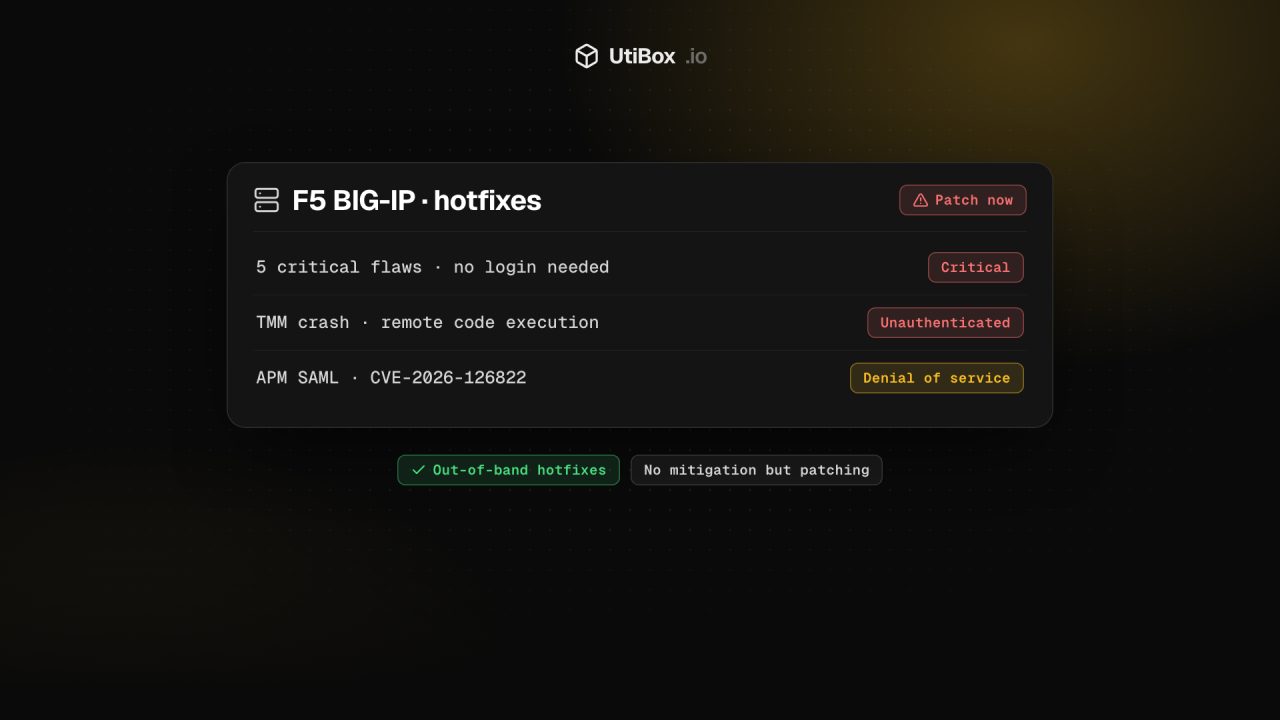
F5 has warned customers to install out-of-band hotfixes for critical BIG-IP flaws that unauthenticated attackers could use to crash traffic handling or run code. F5 says there is no mitigation other than patching.
Illustration: UtiBox
On this page 3 sections
F5 has told customers to patch a group of critical BIG-IP vulnerabilities that remote attackers could use to knock out traffic handling or, in some setups, run their own code. According to BleepingComputer, which reported the story on 20 November 2026, F5 has released out-of-band engineering hotfixes and says it has no other mitigation to offer. If you run BIG-IP, treat this as a priority.
What happened
BleepingComputer reports that F5 warned about five BIG-IP vulnerabilities, all rated critical. Attackers do not need to log in. According to the report, they can use these flaws to terminate the Traffic Management Microkernel (TMM), the component that handles traffic on BIG-IP. They can also execute arbitrary code remotely on systems with vulnerable configurations.
The same report says F5 released hotfixes for a separate, high-severity flaw in BIG-IP APM SAML, tracked as CVE-2026-126822. It is an integer underflow, and an unauthenticated remote attacker could use it for a denial-of-service attack.
F5 said, as quoted by BleepingComputer, that an unauthenticated attacker can cause a denial of service and may also achieve remote code execution. The hotfixes were released on Wednesday, 18 November.
Other outlets count the flaws differently. The headline of one trade report refers to six critical flaws, while BleepingComputer says five. Check F5's own advisory for the exact list of CVE IDs.
The article did not say that these flaws are being exploited. Separately, it noted that F5 patched a critical BIG-IP APM flaw, CVE-2026-94127, in September, and that it was exploited as a zero-day. It also noted that CISA has flagged seven F5 vulnerabilities as exploited since November 2021, four of them also used by ransomware gangs.
Who is affected
The affected systems are BIG-IP devices with vulnerable configurations. The report does not list which configurations or software versions are affected, so I can't state them here. Other write-ups mention iRule and APM features, but I have not confirmed those details against F5's advisory. If you use BIG-IP APM with SAML, the separate SAML denial-of-service flaw may also apply to you.
BIG-IP often sits at the network edge, handling traffic for many applications. A crash of TMM can therefore interrupt every service behind it.
What to do
- Read F5's security advisories for the 18 November 2026 release on my.f5.com. They list the affected versions and the hotfix to install for your branch.
- Install the engineering hotfixes. F5 says it has no mitigation, so patching is the only fix.
- Check F5's notes on special considerations for engineering hotfixes before you upgrade. Hotfixes can behave differently from regular releases.
- Inventory your BIG-IP devices, including any virtual editions and test systems. Note which ones use APM, SAML or iRules.
- Plan a maintenance window. Take a configuration backup (UCS archive) first and test the hotfix on a non-production unit if you can.
- Restrict access to management interfaces and review logs for unexpected TMM restarts, which could be a sign of attempted exploitation.
This story is still developing. UtiBox will update this post if F5 or other sources add confirmed details about versions or active attacks.
Related


More from Server & Security News

CISA flags exploited Puppet Enterprise vulnerability: patch guidance for administrators
CISA added CVE-2026-115731, a code-execution flaw in Puppet Server’s report processing, to its Known Exploited Vulnerabilities catalog on 17 November. Fixed builds are out. Here’s who is exposed,…

Critical NGINX HTTP/2 vulnerabilities disclosed: what website owners must check
NGINX 1.31.9 and 1.30.7 fix CVE-2026-123007 and CVE-2026-123633, two HTTP/2 memory-safety flaws that can lead to code execution. Here’s who is affected, how to check your server, and the stop-gap…

Security alert: Optimizely supply-chain attack exposed visitors across 178 organizations
Attackers abused Optimizely Web Experimentation to inject malicious JavaScript into 188 website scripts tied to 178 organizations on 16 November. The code tried card skimming, crypto-address swaps…


