CISA flags exploited Puppet Enterprise vulnerability: patch guidance for administrators
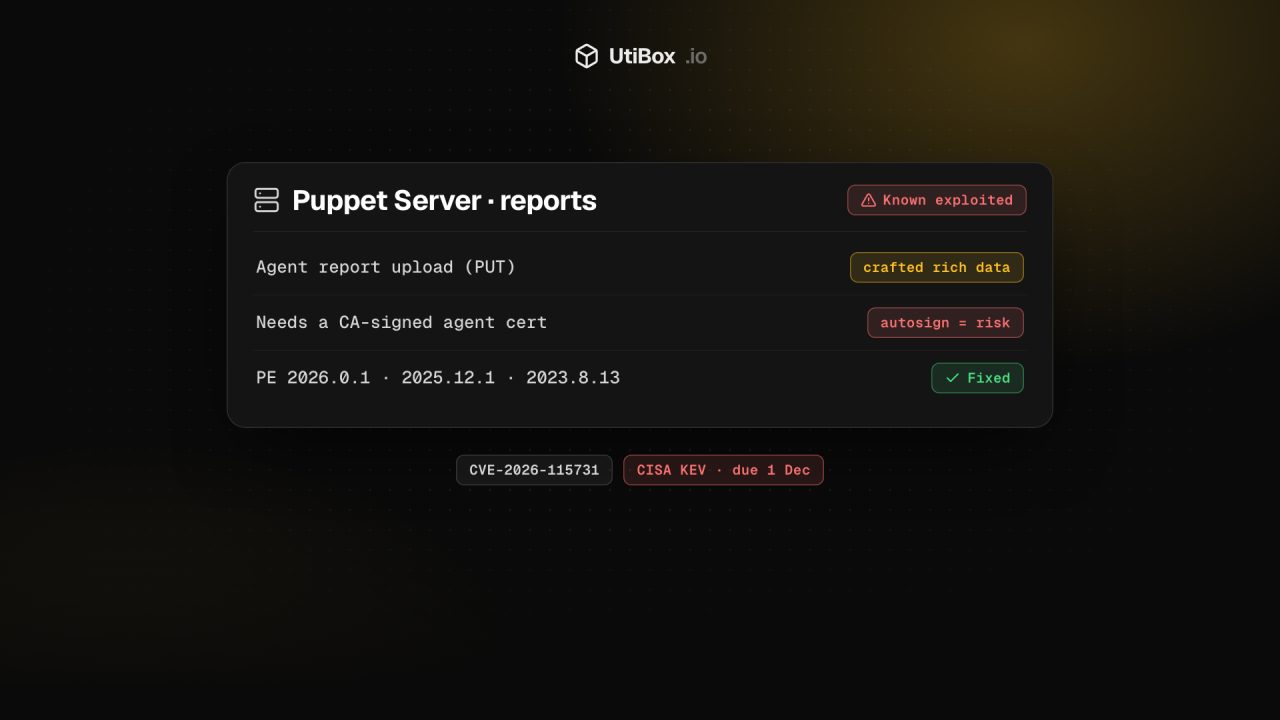
CISA added CVE-2026-115731, a code-execution flaw in Puppet Server’s report processing, to its Known Exploited Vulnerabilities catalog on 17 November. Fixed builds are out. Here’s who is exposed, why certificate autosigning matters, and what to do.
Illustration: UtiBox
What was disclosed
Puppet automates server configuration. A central Puppet Server tells thousands of machines (agents) how to configure themselves, and the agents send back reports of what they did.
CVE-2026-115731 is a flaw in how Puppet Server processes those reports. The National Vulnerability Database describes it as:
Deserialization of untrusted data in the report-processing code of Puppet, as used by Puppet Server, in the affected releases, allows a client that holds any CA-signed agent certificate to execute arbitrary code on the Puppet Server as its service user by submitting a report containing a crafted rich-data type via PUT request.
In plain English: a machine that Puppet trusts can send a specially built report and make the Puppet Server run its code. Because Puppet Server controls the configuration of every managed machine, that is serious. Puppet’s own score is CVSS 4.0 9.4 (critical).
Why certificate autosigning matters
Normally only machines you’ve approved hold a signed agent certificate. NVD adds a warning: “Where the certificate authority autosigns requests without strong verification, an unauthenticated network attacker can obtain such a certificate.”
So if your Puppet CA automatically signs any certificate request, anyone who can reach it may be able to enrol a fake agent, then exploit this flaw. Autosigning that checks a pre-shared secret or an allowlist is much safer than signing everything.
What the CISA listing means, and what it doesn’t
CISA added CVE-2026-115731 to its Known Exploited Vulnerabilities (KEV) catalog on 17 November 2026, with a remediation due date of 1 December 2026 for US federal agencies. A KEV listing means CISA has evidence the vulnerability is being exploited somewhere.
It does not mean your own Puppet Server has been compromised. It means you should treat patching as urgent and check for signs of misuse. CISA’s entry lists ransomware use as “Unknown”.
Affected and fixed versions
From Puppet’s release notes (opens in a new tab), which say the November 2026 security updates fix CVE-2026-115731:
| Product | Fixed in |
|---|---|
| Puppet Enterprise 2026.x | 2026.0.1 |
| Puppet Enterprise 2025.x | 2025.12.1 |
| Puppet Enterprise 2023.8.x (LTS) | 2023.8.13 |
| Puppet Core 9.x / 8.x | 9.1.3 / 8.22.1 |
Earlier releases in those lines are affected. Confirm the exact range for your build in Perforce’s advisory (opens in a new tab) (Perforce support portal sign-in may be required) before you plan the upgrade. If you run an open-source build from another distributor, check that distributor’s advisory.
A safe response plan
- Inventory. List every Puppet Server and compiler, including test and disaster-recovery copies, and record their versions.
- Patch. Upgrade to a fixed release, starting with any server reachable from untrusted networks.
- Review signing. Check whether autosigning is on, and what policy it uses. Tighten it to a verified policy, or sign requests by hand, if it signs everything.
- Review certificates. Look through the signed certificate list for agents you don’t recognise, and revoke any that shouldn’t be there.
- Review logs. Look at Puppet Server and system logs for unexpected processes started by the Puppet service user and unusual report uploads around and before your patch date. If anything looks wrong, treat the server as compromised and follow your incident-response process.
- Limit exposure. Puppet Server’s port should only be reachable by your own agents, not the whole internet.
We don’t publish exploit details or scanning instructions. Checking your own systems from the inside, against the vendor’s advisory, is the safe way to find out where you stand.
Sources
- CISA: Known Exploited Vulnerabilities catalog (opens in a new tab) and its JSON feed (opens in a new tab) (entry added 17 November 2026; read 18 November 2026)
- NIST NVD: CVE-2026-115731 (opens in a new tab)
- Perforce: Report Deserialization Code Execution (CVE-2026-115731) (opens in a new tab)
- Puppet: Updates and releases for Puppet Enterprise (opens in a new tab)
Related


More from Server & Security News

Drupal cuts minor-version security support to 8 months: dates to plan for
From 2027 each Drupal core minor release gets 8 months of security coverage instead of 12, because AI tools have flooded the security team with reports. Drupal 10 and Drupal 11.3 both lose support…

AI agents found and used a MONAI Label zero-day to take over a university server
Amazon says a China-linked attacker used the open-source Cairn framework to find a path traversal flaw in MONAI Label and gain root on a university server. A fix and advisory exist, but the sources…

F5 releases emergency hotfixes for critical BIG-IP remote code execution flaws
F5 has warned customers to install out-of-band hotfixes for critical BIG-IP flaws that unauthenticated attackers could use to crash traffic handling or run code. F5 says there is no mitigation…


