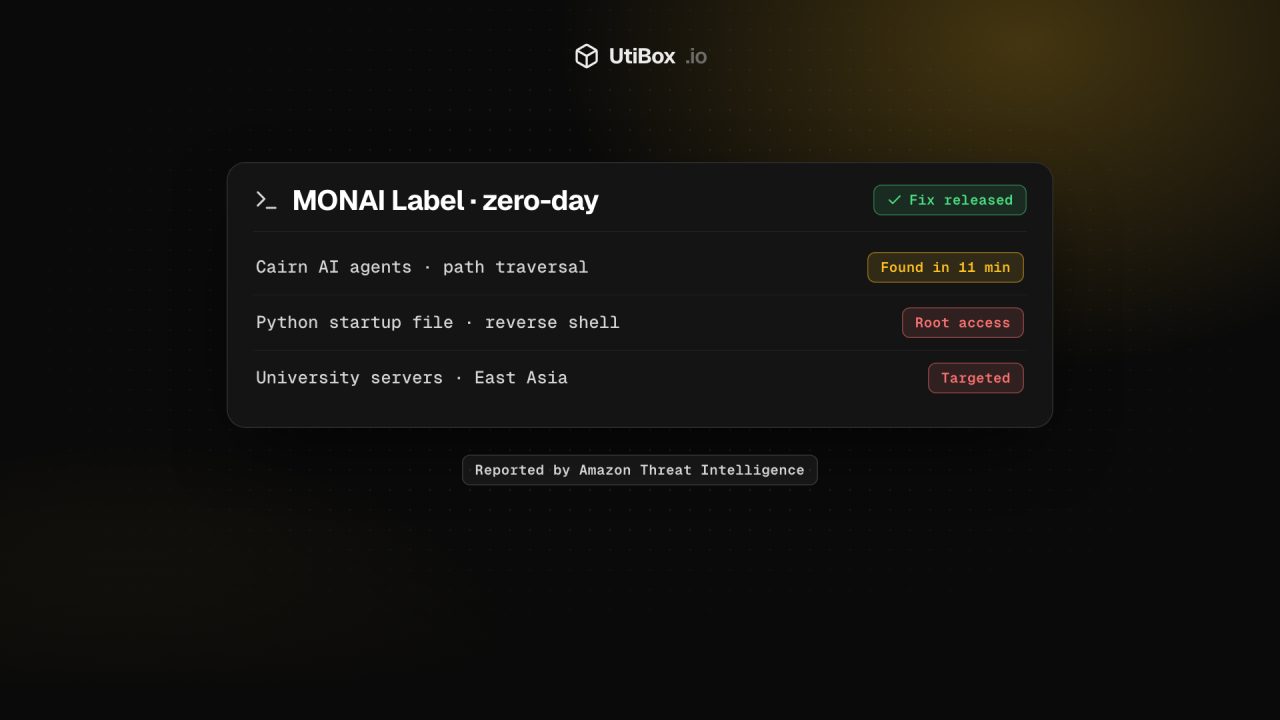
AI agents found and used a MONAI Label zero-day to take over a university server
Amazon says a China-linked attacker used the open-source Cairn framework to find a path traversal flaw in MONAI Label and gain root on a university server. A fix and advisory exist, but the sources don't give a version number.
Illustration: UtiBox
On this page 3 sections
Amazon Threat Intelligence has reported that a suspected China-linked attacker used an AI agent framework called Cairn to discover a previously unknown flaw in MONAI Label, an open-source medical imaging tool, and then take control of a university server. Anyone running MONAI Label, especially on a network that can be reached from outside, should check that they have the project's fix.
What happened
Cairn is an open-source penetration-testing framework that coordinates several AI agents. According to BleepingComputer, which cites Amazon, the agents found a path traversal bug in MONAI Label. The bug let them write files to any location on the server. The same report says it took 11 minutes to go from mapping the application's API to exploiting the flaw.
In a later session, the agents wrote a Python reverse shell into a file that Python loads automatically at startup. They then called an API endpoint to trigger it, which gave them root access, according to BleepingComputer. The operator reportedly told the agents only to obtain shell access and left them to work out the rest.
The attacker then pointed the agents at a second university network running the same software. Amazon found the campaign after the attackers left their Cairn instance open to the internet with no authentication. According to The Register, Amazon told the project's maintainers, who released a fix and a security advisory. The Record says Amazon judged it a zero-day with high confidence, because it found no earlier fix, advisory or database entry.
Not everything worked. BleepingComputer notes the agents tried more than 30,000 credential combinations against a university GPU server over six hours and failed.
Who is affected
The known victims are universities in East Asia, according to The Record. Anyone who runs MONAI Label is potentially exposed, including research labs, hospitals and anyone hosting it in the cloud. The sources I found don't give a CVE number, the affected version range or the fixed version, so check the project's own advisory for those.
Don't confuse this with the older MONAI core flaw CVE-2026-21851. That is a different bug in a different function.
What to do
- Find every MONAI Label server you run, including test and lab machines, and note the installed version.
- Read the MONAI Label security advisories on the project's GitHub page and update to the release that the advisory names as fixed.
- Do not expose the MONAI Label API directly to the internet. Put it behind a VPN or an authenticated reverse proxy, or restrict it by IP address.
- Run the service as a non-root user, ideally in a container, so a file-write bug does not become full server control.
- Look for unexpected changes to sitecustomize.py or other Python startup files, odd outbound connections from the server, and strange requests to the API in your logs.
- If you find signs of compromise, treat the server as breached. Rebuild it and rotate any credentials it could reach.
The wider lesson is about speed. Tools like Cairn let attackers probe niche software quickly, so lesser-known research applications are no longer safe because they are obscure.
Sources: BleepingComputer (opens in a new tab), The Register (opens in a new tab), The Record (opens in a new tab)
Related


More from Server & Security News

PHP 8.6 is out, and every supported PHP version gets security fixes: an analysis
PHP 8.6.0 arrived on 19 November with partial function application, clamp(), a Duration class and a new polling API. The same day, PHP 8.5.13, 8.4.28, 8.3.37 and 8.2.36 fixed security bugs the PHP…

CISA flags exploited Puppet Enterprise vulnerability: patch guidance for administrators
CISA added CVE-2026-115731, a code-execution flaw in Puppet Server’s report processing, to its Known Exploited Vulnerabilities catalog on 17 November. Fixed builds are out. Here’s who is exposed,…

Critical NGINX HTTP/2 vulnerabilities disclosed: what website owners must check
NGINX 1.31.9 and 1.30.7 fix CVE-2026-123007 and CVE-2026-123633, two HTTP/2 memory-safety flaws that can lead to code execution. Here’s who is affected, how to check your server, and the stop-gap…


