Critical NGINX HTTP/2 vulnerabilities disclosed: what website owners must check
NGINX 1.31.9 and 1.30.7 fix CVE-2026-123007 and CVE-2026-123633, two HTTP/2 memory-safety flaws that can lead to code execution. Here’s who is affected, how to check your server, and the stop-gap if you can’t patch today.
Illustration: UtiBox
What was disclosed
On 18 November 2026 F5, which develops NGINX, published fixes for a set of NGINX vulnerabilities. CERT-EU, the EU institutions’ cybersecurity service, summarised them the same day in Security Advisory 2026-022 (opens in a new tab). It says the flaws let “an unauthenticated remote attacker” run code with the privileges of the NGINX worker process.
Two of them involve HTTP/2, the protocol most HTTPS sites now use to send many requests over one connection:
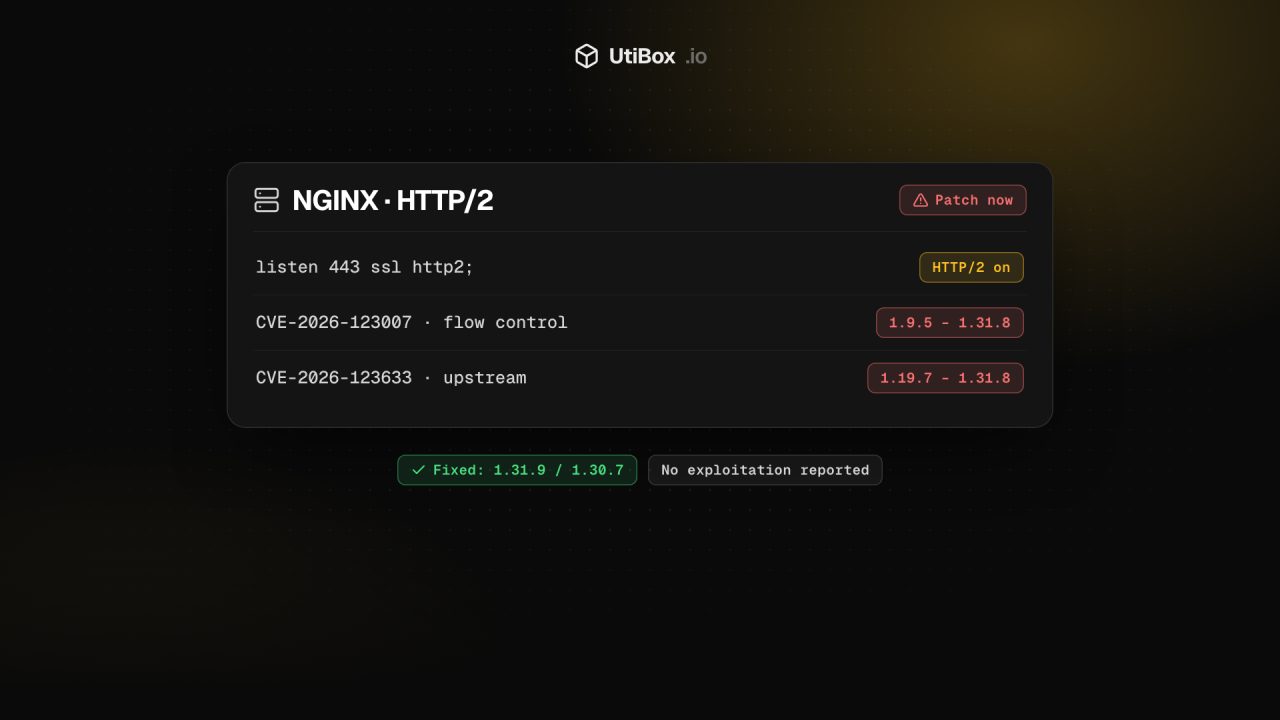
- CVE-2026-123007, “Memory corruption in HTTP/2 flow control”. nginx.org rates it major. CERT-EU describes an integer overflow in HTTP/2 flow control that causes an out-of-bounds write on the heap. Its only precondition, CERT-EU says, is “HTTP/2 enabled on a listening port.”
- CVE-2026-123633, “Use-after-free in HTTP/2”. nginx.org rates it medium. CERT-EU says it happens when connection draining closes an active HTTP/2 connection while NGINX is connecting to an upstream server. So it needs HTTP/2 and NGINX acting as a reverse proxy (
proxy_passand similar).
CERT-EU lists both at CVSS 8.1. The same release fixes other bugs too, including CVE-2026-121810 (HTTP/3), CVE-2026-123634 (resolver) and CVE-2026-113425 (mail proxy). Each of those needs a specific configuration that this article doesn’t cover in detail.
Is it being exploited?
Keep three things apart:
- Public disclosure. Yes: F5 and nginx.org published advisories on 18 November.
- Proof of concept. CERT-EU says researchers demonstrated CVE-2026-123007 and links their write-up.
- Exploitation in the wild. CERT-EU says “no exploitation in the wild has been reported yet.” When we checked CISA’s Known Exploited Vulnerabilities catalog on 18 November 2026, neither CVE was listed.
Exploitation often follows quickly once a technical write-up is public, so don’t wait for that to change before patching.
Affected and fixed versions
From the nginx.org security advisories (opens in a new tab):
| Vulnerability | Affected NGINX Open Source | Fixed |
|---|---|---|
| CVE-2026-123007 (HTTP/2 flow control) | 1.9.5 through 1.31.8 | 1.31.9 (mainline), 1.30.7 (stable) |
| CVE-2026-123633 (HTTP/2 use-after-free) | 1.19.7 through 1.31.8 | 1.31.9 (mainline), 1.30.7 (stable) |
For NGINX Plus, CERT-EU lists 37.0.0 to 37.0.7.1, 37.1.0 to 37.2.0.1 and releases R34, R35 and R36 as affected across the set. Check F5’s own article (K000163926 (opens in a new tab) for CVE-2026-123007) for the fixed build of your release.
A note on Linux packages. Debian, Ubuntu, Red Hat and others often copy a fix into the version they already ship (a backport). So nginx -v can print an “old” number on a server that is already patched. Check your distribution’s security notice for each CVE, not just the version string.
How to check your server
You need shell access. Command names and paths vary between systems.
- Find the version:
nginx -v - See whether HTTP/2 is on:
nginx -T 2>/dev/null | grep -nE 'http2'. Look forlisten … http2orhttp2 on;. - See whether NGINX proxies to an upstream (relevant for CVE-2026-123633):
nginx -T 2>/dev/null | grep -nE 'proxy_pass|grpc_pass|fastcgi_pass|uwsgi_pass' - Check your package against your distribution’s advisory:
apt changelog nginx | head -40on Debian/Ubuntu, orrpm -q --changelog nginx | head -40on RHEL-family systems.
Patch safely
- Install the fixed build from a trusted source: your distribution’s repository, nginx.org’s official packages, or F5 for NGINX Plus.
- Test the configuration before reloading:
nginx -t - Reload (or restart, if your package asks you to) in a quiet period:
systemctl reload nginx - Confirm the site still answers over HTTPS. Our HTTP status checker and SSL certificate checker will show whether the site responds and the certificate is still served correctly.
If you can’t patch today
CERT-EU says that disabling HTTP/2 on exposed listeners mitigates CVE-2026-123007 and CVE-2026-123633 only. Remove http2 from listen directives, or set http2 off;, then test and reload.
This is a stop-gap, not a fix:
- Browsers fall back to HTTP/1.1, which can be slower for pages with many files.
- gRPC services need HTTP/2 and will stop working.
- It does nothing for the HTTP/3, resolver or mail-proxy bugs fixed in the same release.
Plan the real upgrade, then switch HTTP/2 back on.
CERT-EU also suggests watching the error log for “worker process … exited on signal”. It warns that this may show exploitation attempts but is not a reliable sign that code was actually run.
Plesk, Docker and managed hosting: which NGINX is yours?
NGINX often sits in more than one place, and each copy needs checking:
- Plesk runs NGINX as a reverse proxy in front of Apache by default, using its own packaged build. Install Plesk’s updates, then check
nginx -vagain. If you also run Apache with HTTP/2, see our Apache HTTP/2 CVE-2026-119618 guide. - Docker and Kubernetes: an
nginximage, an ingress controller or a sidecar proxy has its own copy. Pull the patched image tag and redeploy. Updating the host’s NGINX doesn’t update containers. - Managed hosting and CDNs: if your host or CDN runs the front-end proxy, it’s their job to patch it. Ask them, or check their status and security pages. Your own server may still run NGINX behind them.
What UtiBox can and can’t tell you
Our tools check what a website shows from the outside: whether it answers, its headers, its certificate. They can’t confirm your NGINX version is patched, and they can’t detect this server-side memory-corruption flaw. Many servers hide their version, and backports make version numbers unreliable anyway. Only a check on the server itself, against your vendor’s advisory, can answer that.
Sources
- CERT-EU: Security Advisory 2026-022, Critical vulnerabilities in NGINX (opens in a new tab) (18 November 2026)
- nginx.org: nginx security advisories (opens in a new tab)
- F5: K000163926, CVE-2026-123007 (opens in a new tab)
- CISA: Known Exploited Vulnerabilities catalog (opens in a new tab) (checked 18 November 2026)
Related


More from Server & Security News

Drupal cuts minor-version security support to 8 months: dates to plan for
From 2027 each Drupal core minor release gets 8 months of security coverage instead of 12, because AI tools have flooded the security team with reports. Drupal 10 and Drupal 11.3 both lose support…

AI agents found and used a MONAI Label zero-day to take over a university server
Amazon says a China-linked attacker used the open-source Cairn framework to find a path traversal flaw in MONAI Label and gain root on a university server. A fix and advisory exist, but the sources…

F5 releases emergency hotfixes for critical BIG-IP remote code execution flaws
F5 has warned customers to install out-of-band hotfixes for critical BIG-IP flaws that unauthenticated attackers could use to crash traffic handling or run code. F5 says there is no mitigation…


