Drupal cuts minor-version security support to 8 months: dates to plan for
From 2027 each Drupal core minor release gets 8 months of security coverage instead of 12, because AI tools have flooded the security team with reports. Drupal 10 and Drupal 11.3 both lose support in December 2026. Here are the new dates and how to check where your site stands.
Illustration: UtiBox
On 2 November 2026 the Drupal Security Team published a public service announcement, PSA-2026-11-02, with a change every Drupal site owner should put in the calendar. From 2027, each minor version of Drupal core (11.4, 11.5, 12.0 and so on) will get 8 months of overlapping security coverage instead of 12.
Major versions keep their promise of at least four years. What shrinks is the time you can stay on one minor release before you have to move to the next.
Why Drupal is doing this
The Security Team is blunt about the reason. Like other open-source projects, Drupal is dealing with what it calls a “tsunami” of security reports driven by AI tools, and this “has created more work than the Drupal Security Team, especially with its current levels of funding, can sustain.”
The team warns that this creates a risk for site owners: “security fixes will take longer to release, which gives more time for malicious actors armed with LLMs to find attacks.” Shorter support windows mean fewer old branches to backport fixes to. Drupal expects the change to cut backport work for core security advisories by 30%, and says it also lines Drupal up better with the release cycle of Symfony, the PHP framework underneath it.
The new schedule
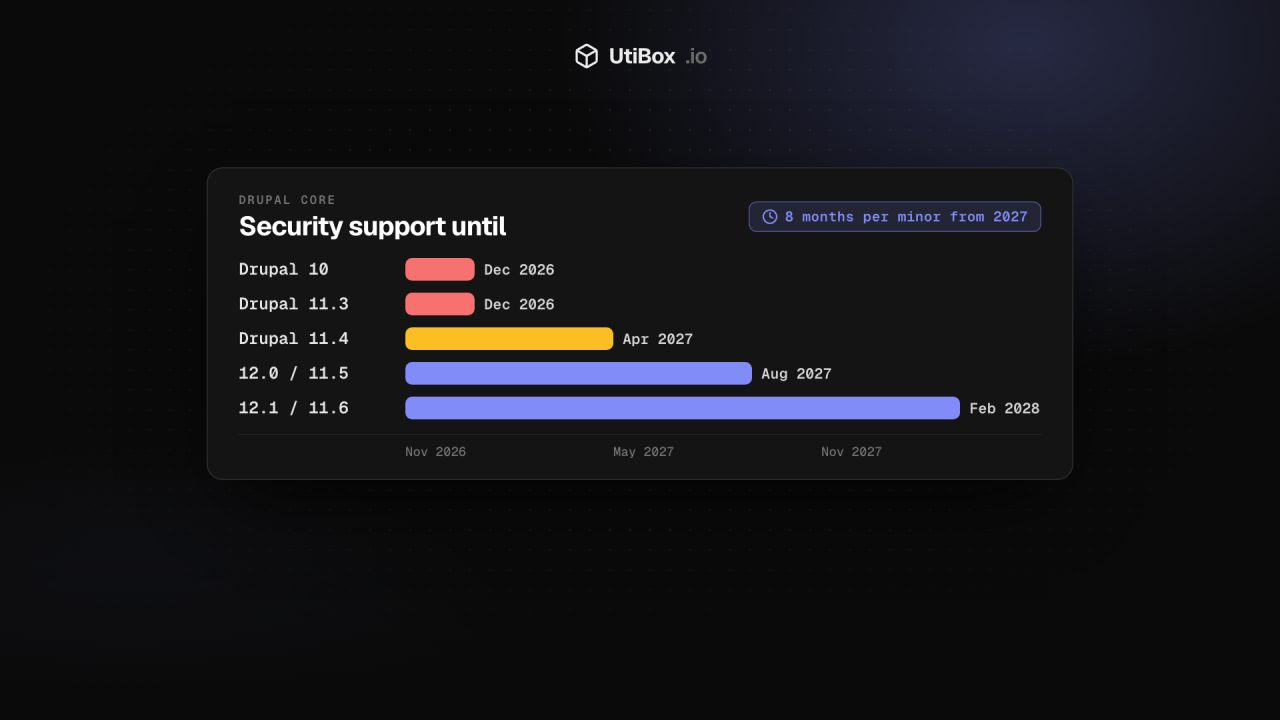
Each minor version will get six months of bug fixes followed by two months of security-only fixes. The last minor version of each major gets six months of bug fixes followed by six months of security fixes.
| Minor version | Security support until |
|---|---|
| Drupal 11.3 | December 2026 |
| Drupal 11.4 (released June 2026) | April 2027 |
| Drupal 12.0 and 11.5 (scheduled for December 2026) | August 2027 |
| Drupal 12.1 and 11.6 (scheduled for June 2027) | February 2028 |
And for whole major versions:
| Major version | Security support until |
|---|---|
| Drupal 10 | December 2026 |
| Drupal 11 | December 2028 |
| Drupal 12 (scheduled for December 2026) | December 2030 |
The PSA gives months, not days, so don’t leave an upgrade to the last week of a month. On 6 November 2026 Drupal released 11.4.12, 11.3.21 and 10.6.21, and its update feed lists 10.6, 11.3 and 11.4 as the supported stable branches, with 11.5 and 12.0 in beta.
What this means for your site
On Drupal 10? December 2026 is close. Drupal 10 security coverage ends then, so the move to Drupal 11 needs to happen now, not next year. Upgrade to the latest 11.4 release, not 11.3, because 11.3 also ends in December.
On Drupal 11.3? Plan the step to 11.4 (or 11.5 once it ships in December) before the end of 2026.
On 11.4? You’re covered until April 2027. Expect to move to 11.5 or 12.x early in 2027.
Generally: with 8-month windows, falling two minor releases behind will leave a site without security fixes. Treat minor upgrades as routine maintenance, roughly twice a year, rather than a project you get round to.
How to check your version
With Drush or Composer on the server:
drush status --field=drupal-version
composer show drupal/core | grep versions
In the admin interface, Reports → Status report shows the core version, and Reports → Available updates warns when your branch has dropped out of security support.
On shared hosting or a managed platform, ask your provider which Drupal version you’re running and when they plan to upgrade it. If your agency maintains the site, send them the PSA link and ask for dates.
Plan the upgrade
- Check your modules and themes first. Contributed modules must support the target version. The Upgrade Status module and the project pages on drupal.org show compatibility.
- Upgrade on a copy. Clone the site to staging, upgrade there, run the database updates (
drush updatedb) and test forms, logins and anything that takes payments. - Update PHP alongside it. Newer Drupal releases need newer PHP, and older PHP versions are also reaching end of life. Our post on PHP 8.6 and the end of PHP 8.2 has the PHP dates.
- Keep watching contributed module advisories. Most Drupal security advisories are for contributed modules, not core. On 4 November 2026 alone, drupal.org published 24 advisories for contributed modules, nine of them rated Critical. Subscribe to the security announcements so you see them on the day.
After an upgrade, a quick external check is worthwhile. The Website Health Report confirms the site answers correctly over HTTPS and shows which security headers it sends, which makes a handy before-and-after comparison.
Sources
Related


More from Server & Security News

CISA flags exploited Puppet Enterprise vulnerability: patch guidance for administrators
CISA added CVE-2026-115731, a code-execution flaw in Puppet Server’s report processing, to its Known Exploited Vulnerabilities catalog on 17 November. Fixed builds are out. Here’s who is exposed,…

Critical NGINX HTTP/2 vulnerabilities disclosed: what website owners must check
NGINX 1.31.9 and 1.30.7 fix CVE-2026-123007 and CVE-2026-123633, two HTTP/2 memory-safety flaws that can lead to code execution. Here’s who is affected, how to check your server, and the stop-gap…

Security alert: Optimizely supply-chain attack exposed visitors across 178 organizations
Attackers abused Optimizely Web Experimentation to inject malicious JavaScript into 188 website scripts tied to 178 organizations on 16 November. The code tried card skimming, crypto-address swaps…


