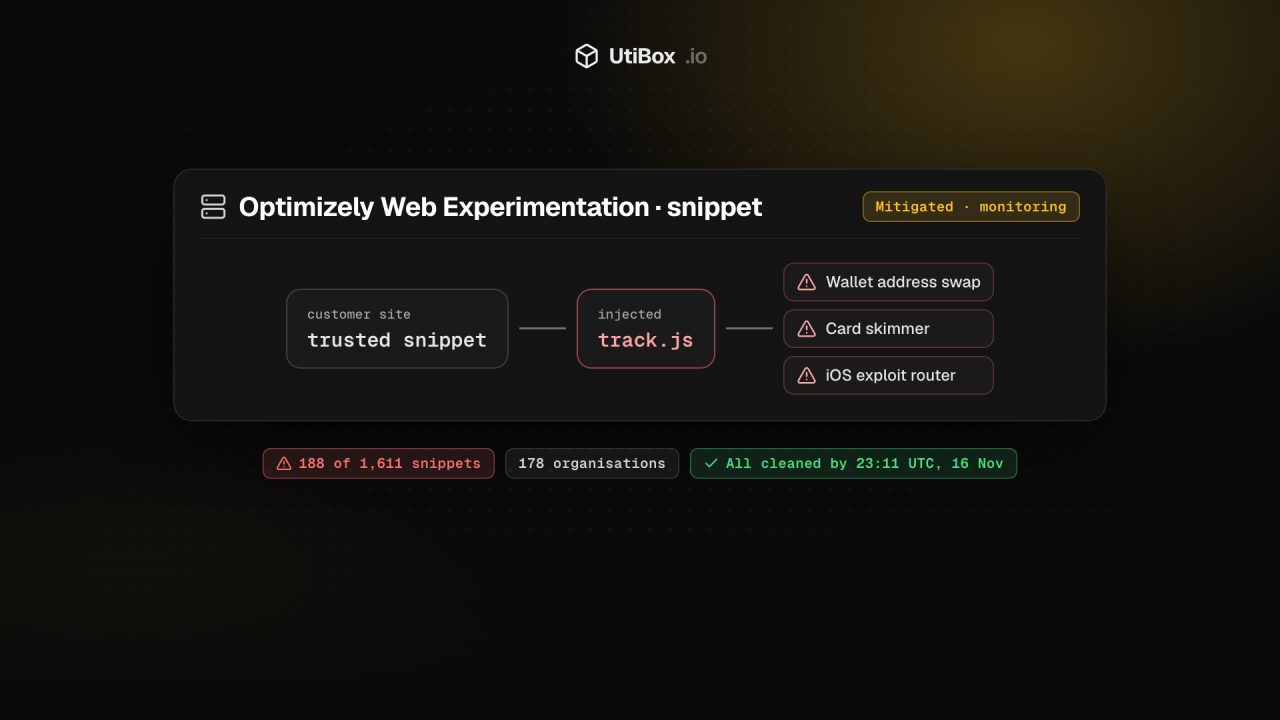
Security alert: Optimizely supply-chain attack exposed visitors across 178 organizations
Attackers abused Optimizely Web Experimentation to inject malicious JavaScript into 188 website scripts tied to 178 organizations on 16 November. The code tried card skimming, crypto-address swaps and iOS exploits. Here’s what happened and what to do.
Illustration: UtiBox
What happened
On 16 November, security researchers found malicious JavaScript being delivered through Optimizely Web Experimentation, a third-party service that businesses use to test, optimize and personalize their websites.
Report URI examined 1,611 Optimizely JavaScript snippets and found 188 compromised snippets associated with 178 organizations. The code came from a service those websites already trusted. That is what makes a supply-chain attack dangerous: visitors can be exposed even when a company’s own servers were never breached.
Optimizely later confirmed that an unauthorized party exploited a vulnerability in its Experimentation account signup flow and used it to add malicious code to customer projects. The company told BleepingComputer it blocked access to the vulnerable path, deployed a fix, removed the injected code, secured affected accounts and put additional protections in place.
Which organizations were named
The researchers’ list covers finance, technology, retail, media, travel and other sectors. Examples named in the research and in independent reporting:
| Sector | Examples named |
|---|---|
| Technology | Zoom, Salesforce, GitLab, Bitly |
| News and media | BBC, CNN, Fox News |
| Banking and financial services | HSBC, Equifax, Paychex |
| Retail | IKEA, ASOS, American Eagle |
| Travel | Air France-KLM, Alaska Airlines / Hawaiian Airlines |
| Entertainment and other services | Peacock, Ledger, Change.org |
Being named doesn’t mean a company suffered a customer-data breach. Some companies investigated or switched off the affected script as a precaution, and how much harm reached visitors hasn’t been established. The full organization and domain list is in Report URI’s original investigation (opens in a new tab).
What the malicious code could do
Researchers analysed a multi-purpose payload:
- Cryptocurrency address swapping. It could replace the wallet address a visitor meant to pay with one the attacker controls.
- Payment-card skimming. Later versions tried to capture card numbers, expiry dates and security codes typed into the affected websites’ own forms.
- Browser-data collection. It could send the page address, readable cookies and a screenshot of the page. Cookies marked
HttpOnlycan’t be read by ordinary page JavaScript. - iPhone and iPad exploit delivery. It could send devices to infrastructure linked to the Coruna and DarkSword iOS exploit kits. That confirms an attempt to deliver exploits, not that every device was infected.
Researchers saw transactions involving cryptocurrency wallets tied to the campaign. How much was stolen because of this attack is still unclear, because some of those wallets were active before it. The numbers of exposed cards, stolen sessions and infected devices haven’t been published.
Timeline
All times are UTC (Eastern is five hours behind).
| Date and time (UTC) | What happened |
|---|---|
| 16 Nov, 04:21 | Earliest Optimizely injection in Report URI’s timeline (a BBC-related script) |
| 16 Nov, 13:43 | Card-skimming code added to the payload |
| 16 Nov, about 20:40 to 21:10 | Widespread clean-up of infected snippets |
| 16 Nov, 23:11 | Report URI confirms all 188 compromised snippets are clean |
| 17 Nov, 01:02 | Optimizely posts its security incident update: fixed, injected code removed, monitoring |
| 17 Nov, 09:17 | Report URI update: still clean; the attacker’s domains are being taken down |
UtiBox classification: Mitigated, monitoring. This is a security incident. It isn’t a sign that any named company’s website is down.
What visitors should do
If you visited one of the named websites on 16 November, take the steps that match what you did there:
- Update your iPhone or iPad. Install the latest iOS or iPadOS update your device supports, especially if you browsed an affected site on an older version.
- Check your card statements. If you entered card details on a possibly affected page, watch your statements and report anything you don’t recognise to your bank or card provider straight away.
- Check cryptocurrency transfers. Compare the recipient address and history of any transfer you made while an affected page was open. Blockchain transfers usually can’t be reversed.
- Watch for unusual account activity. Look out for unexpected sign-in alerts or security changes. If you think a password or session was exposed, change the password and sign out other sessions using the service’s own security settings.
- Use official channels. Read the organization’s own advisory before acting, and ignore unsolicited messages offering an automatic “security fix”.
Simply visiting a named site doesn’t mean your data was stolen or your device infected. The risk depends on the page, when you visited, your device and what you did there.
What website owners and security teams should do
If you load Optimizely Web Experimentation, or any third-party JavaScript:
- Find affected projects. List the Optimizely snippets on your public sites and check the Project JavaScript and experiment code for changes you didn’t make.
- Review logs and change history. Work out whether malicious code was served during the exposure window. A script that’s clean now doesn’t rule out what it served before.
- Review account security. Audit account access, active sessions, API tokens and integrations. Rotate exposed credentials and revoke suspicious sessions.
- Assess customer impact. Start with pages that take card details, expose sensitive data to scripts, or show cryptocurrency wallet addresses.
- Tighten your Content Security Policy. Enforce restrictive
script-srcandconnect-srcrules where you can, avoidunsafe-evalwhere it isn’t needed, and monitor CSP violations. Test changes so the site doesn’t break. - Monitor third-party scripts. Consider script-change monitoring, browser-side telemetry and alerts for unexpected outbound connections. Static Subresource Integrity hashes rarely suit scripts that change often by design, so choose a control that fits the dependency.
- Check your notification duties. If you find credible exposure of customer data, follow the notification rules that apply to you and your incident-response plan.
Check your site’s security headers
Indicators for defenders
These are defanged so they can’t be opened by accident. Use them for threat hunting, searching historical logs and blocking; don’t open them in a browser.
| Indicator | Reported role |
|---|---|
1688360[.]cc | Main payload and data-collection host |
5vobauua3ojpklx[.]icu | iOS exploit-delivery router |
eil786npto9u5bq[.]icu | Second iOS router |
webshell[.]lol | Injector used in an earlier, related wave |
Report URI keeps the complete, current indicator list and hashes in its original research (opens in a new tab). Some of this infrastructure was already being taken down by 17 November. Matching your historical logs is still useful even when a domain no longer answers.
What isn’t confirmed yet
So far, public evidence doesn’t establish:
- how many visitors had payment details or browser data stolen;
- how many iPhones or iPads were compromised through the exploit kits;
- exactly how much cryptocurrency this campaign stole;
- a direct internal breach at any named organization;
- the full set of affected websites beyond those researchers could examine.
We’ll keep confirmed findings separate from early reports and vendor statements if we update this post.
Sources
- Report URI (Scott Helme), original investigation, 16 November, updated 17 November: World’s Largest Brands Infected With Malware Via Optimizely (opens in a new tab)
- Optimizely, official status page: Web Experimentation Security Incident (opens in a new tab)
- BleepingComputer, independent reporting and Optimizely’s statement: Optimizely hack infected CNN, Fox News, BBC, Salesforce sites with malware (opens in a new tab)
- Reuters, 17 November: Popular websites compromised in bid to steal crypto, target iPhone users (opens in a new tab)
- Newsweek: Cyber Attack Hits 178 Major Websites: Full List of Affected Organizations (opens in a new tab)
UtiBox security announcements are independently checked and meant to support public awareness and defensive decisions. Incident status and technical findings can change as investigators and vendors publish updates. For authoritative remediation details, follow the affected provider and the primary research linked above.
Related


More from Server & Security News

PHP 8.6 is out, and every supported PHP version gets security fixes: an analysis
PHP 8.6.0 arrived on 19 November with partial function application, clamp(), a Duration class and a new polling API. The same day, PHP 8.5.13, 8.4.28, 8.3.37 and 8.2.36 fixed security bugs the PHP…

CISA flags exploited Puppet Enterprise vulnerability: patch guidance for administrators
CISA added CVE-2026-115731, a code-execution flaw in Puppet Server’s report processing, to its Known Exploited Vulnerabilities catalog on 17 November. Fixed builds are out. Here’s who is exposed,…

Critical NGINX HTTP/2 vulnerabilities disclosed: what website owners must check
NGINX 1.31.9 and 1.30.7 fix CVE-2026-123007 and CVE-2026-123633, two HTTP/2 memory-safety flaws that can lead to code execution. Here’s who is affected, how to check your server, and the stop-gap…


