Critical Apache HTTP/2 flaw CVE-2026-119618: what website owners should patch
Apache HTTP Server 2.4.71 fixes CVE-2026-119618, a critical bug in mod_http2 that can lead to remote code execution. Versions 2.4.55 to 2.4.70 are affected. Here’s how to check your server and patch it safely.
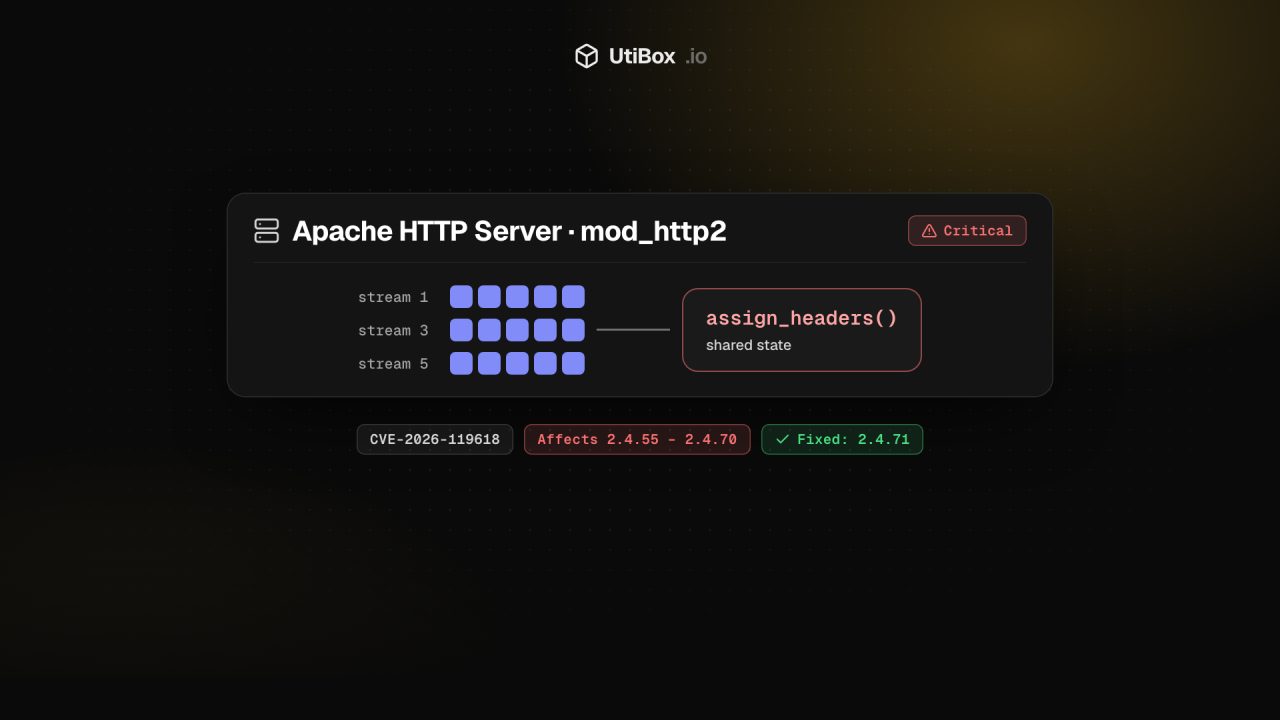
Illustration: UtiBox
What was disclosed
On 11 November 2026 the Apache HTTP Server project released version 2.4.71. It fixes three security bugs, and one of them is rated critical. Apache’s advisory lists it as CVE-2026-119618, titled “mod_http2: heap corruption and RCE in assign_headers”:
Concurrent Execution using Shared Resource with Improper Synchronization vulnerability in Apache HTTP Server’s mod_http2 in assign_headers() can lead to RCE.
Apache HTTP Server security advisory
In plain English: mod_http2 is the part of Apache that speaks HTTP/2. HTTP/2 carries many requests at once over one connection. In the affected versions, a function that sets up response headers can touch shared memory from two places at once without the right locking. That can corrupt memory, and Apache says the result can lead to remote code execution (RCE). RCE means an attacker could run their own code on the web server.
Apache credits two independent finders: Anthropic’s OSS Scanner, which reported it on 26 October, and Anthony Weems and Simon Scannell of Google Cloud Vulnerability Research, who reported it on 3 November.
Is it being exploited?
Apache’s advisory doesn’t say the bug is being exploited. When we checked on 15 November 2026, it wasn’t in CISA’s Known Exploited Vulnerabilities catalog either. That can change quickly once a fix is public, so don’t wait for that list before patching.
Affected and fixed versions
| Software | Affected | Fixed |
|---|---|---|
| Apache HTTP Server | 2.4.55 through 2.4.70 | 2.4.71 (11 November 2026) |
| mod_h2, standalone from GitHub | 2.0.8 through 2.0.42 | Apache’s advisory doesn’t name a fixed mod_h2 release |
2.4.71 also fixes two lesser bugs. CVE-2026-106023 (important) is a crash in mod_md, which handles automatic certificates, in 2.4.30 to 2.4.70. CVE-2026-109163 (low) is a one-byte overwrite in mod_vhost_alias in 2.4.69 and 2.4.70.
A note on Linux packages. Debian, Ubuntu, Red Hat and most other distributions don’t always ship the newest upstream version. They often copy the fix into the version they already ship. That’s called a backport. So apache2 -v might print 2.4.6x on a server that is already patched, or on one that isn’t. The version number alone can’t tell you which. Check your distribution’s security notice for CVE-2026-119618, or the package changelog (commands below).
How to check your server
You need shell access to the server. Command names and paths vary by system: Debian and Ubuntu use apache2 and apache2ctl, while Red Hat, Alma, Rocky and Fedora use httpd and apachectl.
Step 1: which version is installed?
apache2 -v        # Debian / Ubuntu
httpd -v          # Red Hat family, most others
Step 2: is mod_http2 loaded?
apache2ctl -M | grep -i http2 # or: apachectl -M | grep -i http2If nothing comes back, Apache isn’t loading mod_http2. CVE-2026-119618 sits in that module, but install the update anyway: 2.4.71 also fixes the other two bugs.
Step 3: is HTTP/2 actually switched on? Look for a Protocols line that includes h2:
grep -Rni "^\s*Protocols" /etc/apache2 /etc/httpd 2>/dev/nullStep 4: has your distribution patched it? Search the package changelog for the CVE:
apt changelog apache2 | grep -m1 -n CVE-2026-119618     # Debian / Ubuntu
rpm -q --changelog httpd | grep -m1 CVE-2026-119618     # Red Hat family
No match only means the update hasn’t reached your server yet, or your distribution hasn’t published it. Check your distribution’s security tracker.
How to patch safely
Step 1: back up your configuration (/etc/apache2 or /etc/httpd), so you can roll back a broken config. Step 2: install the update. from the same source you installed Apache from: your distribution’s packages, your control panel, or the official 2.4.71 release if you build Apache yourself. If your Apache came with a hosting panel or appliance, wait for that vendor’s update rather than installing a separate copy. Step 3: test the configuration, then restart.
apache2ctl configtest && sudo systemctl restart apache2     # Debian / Ubuntu
apachectl configtest && sudo systemctl restart httpd        # Red Hat family
A full restart makes sure no Apache process is still running the old code.
Step 4: confirm the result. Run the version and changelog checks again, then make sure your sites load.
If you have a staging server, patch that first. But don’t let staging hold up a critical fix for days.
If you can’t patch today (our suggestion, not Apache’s): Apache’s advisory doesn’t list a workaround. Turning HTTP/2 off for a while, by removing h2 from the Protocols lines or not loading mod_http2, stops Apache from using the module where the bug sits. Visitors fall back to HTTP/1.1, which is slower but works. Treat it as a stopgap and patch as soon as you can.
After patching: what a website check can and can’t tell you
Once Apache is back up, use our HTTP Status Checker to confirm your important pages still answer correctly. A healthy 200 OK shows the site is working. It doesn’t show the vulnerability is gone: UtiBox’s website, DNS and SSL checks don’t scan for CVEs. Only the installed version or your vendor’s patch notice can tell you that.
The web server is only one layer. If your sites run PHP, the separate php2shell flaws need their own update. Our php2shell guide covers that, including Plesk servers.
FAQ
Is every Apache website affected? No. Only Apache 2.4.55 to 2.4.70, and the critical bug is in mod_http2. A server without mod_http2 loaded isn’t exposed to CVE-2026-119618, though it should still get 2.4.71 for the other two fixes.
My distribution still shows an older version number. Am I vulnerable? Not necessarily. Distributions often backport fixes without changing the main version number. Check the package changelog or your distribution’s security notice for CVE-2026-119618.
Does UtiBox detect this vulnerability? No. Our tools check whether a site answers, its DNS and its certificate. They can’t see which Apache build a server runs or whether it’s patched.
Has exploitation been confirmed? Not as of 15 November 2026: Apache doesn’t mention it, and CISA hasn’t listed the CVE. We’ll update this post if that changes.
Sources
- Apache HTTP Server project: Apache HTTP Server 2.4 vulnerabilities (opens in a new tab) (CVE-2026-119618, CVE-2026-106023, CVE-2026-109163)
- CISA: Known Exploited Vulnerabilities catalog (opens in a new tab) (checked 15 November 2026)
Related


More from Server & Security News

Drupal cuts minor-version security support to 8 months: dates to plan for
From 2027 each Drupal core minor release gets 8 months of security coverage instead of 12, because AI tools have flooded the security team with reports. Drupal 10 and Drupal 11.3 both lose support…

AI agents found and used a MONAI Label zero-day to take over a university server
Amazon says a China-linked attacker used the open-source Cairn framework to find a path traversal flaw in MONAI Label and gain root on a university server. A fix and advisory exist, but the sources…

F5 releases emergency hotfixes for critical BIG-IP remote code execution flaws
F5 has warned customers to install out-of-band hotfixes for critical BIG-IP flaws that unauthenticated attackers could use to crash traffic handling or run code. F5 says there is no mitigation…


