N-able Mail Assure and SpamExperts security incident: what customers should know
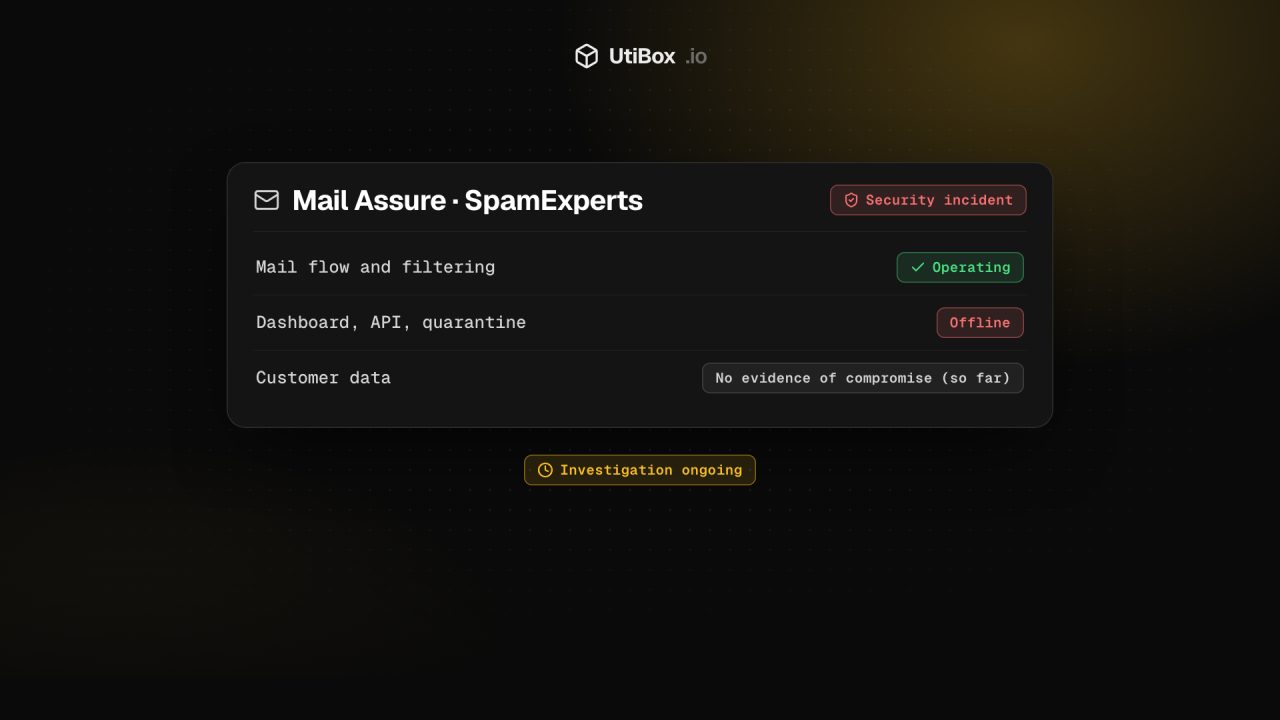
N-able says someone gained unauthorized access to one server in its Mail Assure and SpamExperts Hosted Cloud. Mail flow and filtering continue; dashboards, the API and quarantine are offline while it restores them. Here’s what N-able has confirmed, and what it hasn’t.
Illustration: UtiBox
What happened
N-able sells two hosted email-filtering services, Mail Assure and SpamExperts Hosted Cloud, mostly through IT providers and hosting companies. On 16 November 2026 N-able told customers about a service disruption affecting both. In its incident notice, N-able says that as the investigation continued, it “determined that the disruption was caused by a security incident.”
N-able says it is aware of unauthorized access to one of the servers in the Mail Assure and SpamExperts Hosted Cloud.
N-able also says this incident is unrelated to a separate N-central incident.
What still works, and what doesn’t
According to N-able’s status page:
- Mail flow and filtering continue to operate. Inbound and outbound mail is still being filtered.
- The dashboard, API and quarantine access are offline “while we restore services safely.” That means administrators and end users can’t log in to manage settings or release quarantined mail for now.
These are separate things. A locked dashboard is not the same as mail not being delivered, and N-able hasn’t said that delivery stopped.
Was customer data taken?
N-able says the investigation is ongoing, but that “at this time we do not have evidence that customer data was compromised, including access to tenants’ mailboxes.”
That is a statement about what N-able has found so far. It isn’t a final finding, and we won’t guess beyond it. If N-able’s findings change, we’ll update this article.
What administrators can do now
These steps are ordinary good practice during a vendor incident. Follow N-able’s own guidance first where it differs.
- Follow the official incident page and N-able’s direct notices. Ignore unofficial “fix” instructions.
- Watch for phishing. Incidents attract fake “reset your password” or “release your quarantine” emails. Only sign in through the address you normally use, and only once N-able says access is back.
- Plan for the quarantine gap. Tell users that quarantined messages can’t be released for now, and agree how urgent messages will be handled.
- Check your continuity plan. If your mail routing depends on the filtering service, make sure you know how you’d route mail if you ever had to. Don’t change MX records in a hurry, though. Mail flow is still working, and a rushed change can cause the outage you’re trying to avoid. Our MX lookup shows your current routing.
- Review admin access once the dashboard returns. Look at who has administrator or technician accounts, rotate API keys used by your own integrations, and confirm two-factor authentication is on.
Why UtiBox isn’t showing this as a live outage
UtiBox only shows a provider as having an outage when an official, machine-readable status source says so. N-able’s status dashboard has no public feed or API we can use, so this incident appears here as reporting, not on our status pages.
Sources
- N-able: Status Dashboard incident 202672 (opens in a new tab) (Mail Assure and SpamExperts Hosted Cloud)
- N-able: Status Dashboard (opens in a new tab)
Related


More from News

Apple services disrupted on November 17: what happened to iCloud, the App Store and Apple Music?
An internal update knocked out iCloud sign-in, the App Store, Apple Music and more on Tuesday, 17 November. Apple says it wasn’t a cyberattack, and its status page showed everything resolved by 6…

Chrome adds Global Privacy Control: what Sec-GPC means for your site
Chrome 157 lets users in California send an opt-out request to every site they visit, as a Sec-GPC header. If your site sells or shares personal data for advertising, here’s what the signal is,…

PHP 8.6 is due on 19 November, and PHP 8.2 reaches end of life on 31 December
The PHP project has scheduled PHP 8.6.0 for 19 November 2026. PHP 8.2 gets its last security fixes on 31 December, when PHP 8.4 also drops to security-only support. Here’s what changes, including…


